

Dubai has emerged as one of the world’s most dynamic luxury real estate markets. The combination of tax-free ownership, world-class infrastructure, and ambitious development projects has positioned it as a serious alternative to traditional luxury markets in London, New York, and Singapore.
Dubai provides 100% foreign ownership in designated freehold areas, zero property taxes, and access to long-term residency visas for qualifying property buyers. These structural advantages, combined with a stable political environment and strategic geographic location, have driven sustained demand from investors across Europe, Asia, and North America.
2025 Market Performance Overview
Dubai’s residential market recorded nearly 200,000 transactions in 2025, totaling $146.5 billion (AED 538.1 billion) in value according to Metropolitan Premium Properties’ 2025 market analysis. This represents an 18.9% increase in transaction volume and 26.9% growth in total value year-over-year, demonstrating the market’s sustained momentum.
Average transaction prices reached $732,000 (AED 2.69 million), up 6.7% from 2024, while median prices stood at $416,500 (AED 1.53 million). What makes these figures particularly significant is that the growth came alongside increased transaction volume, indicating genuine market depth.
The market demonstrated resilience across all price segments, with consistent monthly activity above 15,000 transactions from April onwards. The third quarter recorded the highest quarterly volume, with July alone seeing 18,760 transactions.
The $150 Million Bugatti Penthouse: Record-Breaking Sales
December 2025 witnessed Dubai’s most expensive residential transaction to date: a $150 million (AED 550 million) six-bedroom penthouse at Bugatti Residences by Binghatti in Business Bay. This landmark sale underscores Dubai’s position as a destination for ultra-luxury assets that rival the world’s most exclusive markets.
The top ten record transactions of 2025 paint a picture of exceptional luxury demand. A villa in Emirates Hills’ Sector E sold for $115.7 million (AED 425 million) in January, while an August transaction at La Mer’s Jumeirah Asora Bay Ocean Mansions reached $95.3 million (AED 350 million) for a seven-bedroom villa. Palm Jumeirah’s Crescent saw a six-bedroom villa change hands for $81.7 million (AED 300 million) in May.
The concentration of transactions above $60 million signals that Dubai has successfully positioned itself alongside Monaco, Hong Kong, and Miami as a preferred destination for the world’s wealthiest buyers.
Ultra-Luxury Segment Analysis ($5.4M+ properties)
Properties priced above $5.4 million (AED 20 million) represented just 3.3% of total transaction volume in 2025 but contributed significantly to overall market value. This segment recorded 6,651 transactions, demonstrating that Dubai’s luxury market has genuine depth beyond headline-grabbing record sales.
The ultra-luxury segment is characterized by sophisticated buyers who prioritize quality, location, and long-term value over price sensitivity. Many transactions in this tier involve family offices, established entrepreneurs, and executives relocating to Dubai as part of the broader wealth migration trend affecting the UAE.
International buyer profiles in the luxury segment are diverse. British buyers have shown particular interest, with the UAE welcoming roughly 9,800 millionaires in recent years. Buyers from Europe, Asia, and North America are drawn by Dubai’s tax efficiency, security, and cosmopolitan lifestyle. The city’s position as a bridge between East and West makes it attractive to investors with business interests spanning multiple continents.
Dubai’s luxury market also benefits from strong rental yields compared to other global cities. While luxury properties in London or New York might generate 2-4% annual rental returns, Dubai’s luxury segment typically delivers 5-9% depending on location and property type. This combination of capital appreciation and income generation makes the investment case compelling for wealth preservation strategies.
Top Locations for Luxury Properties
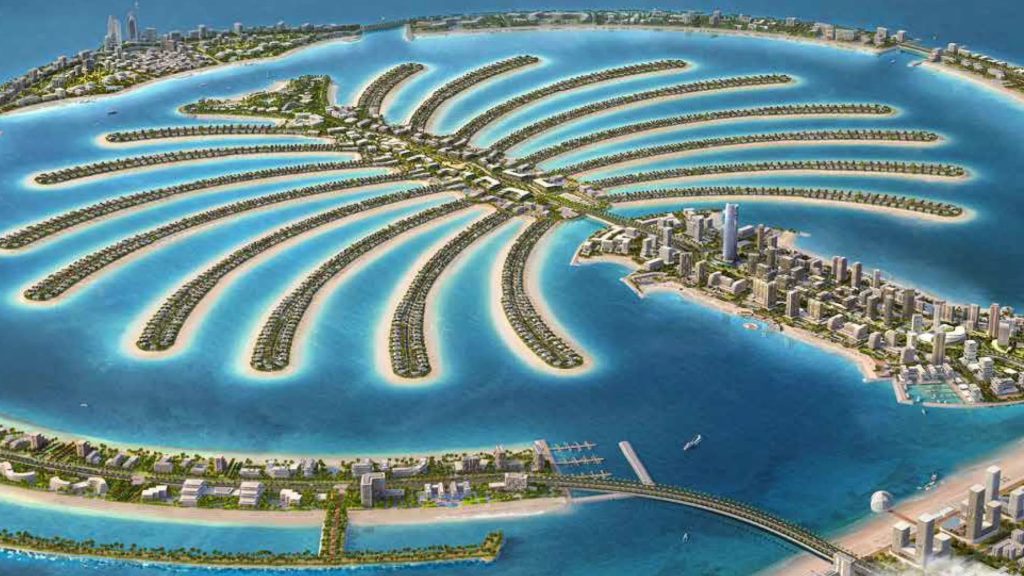
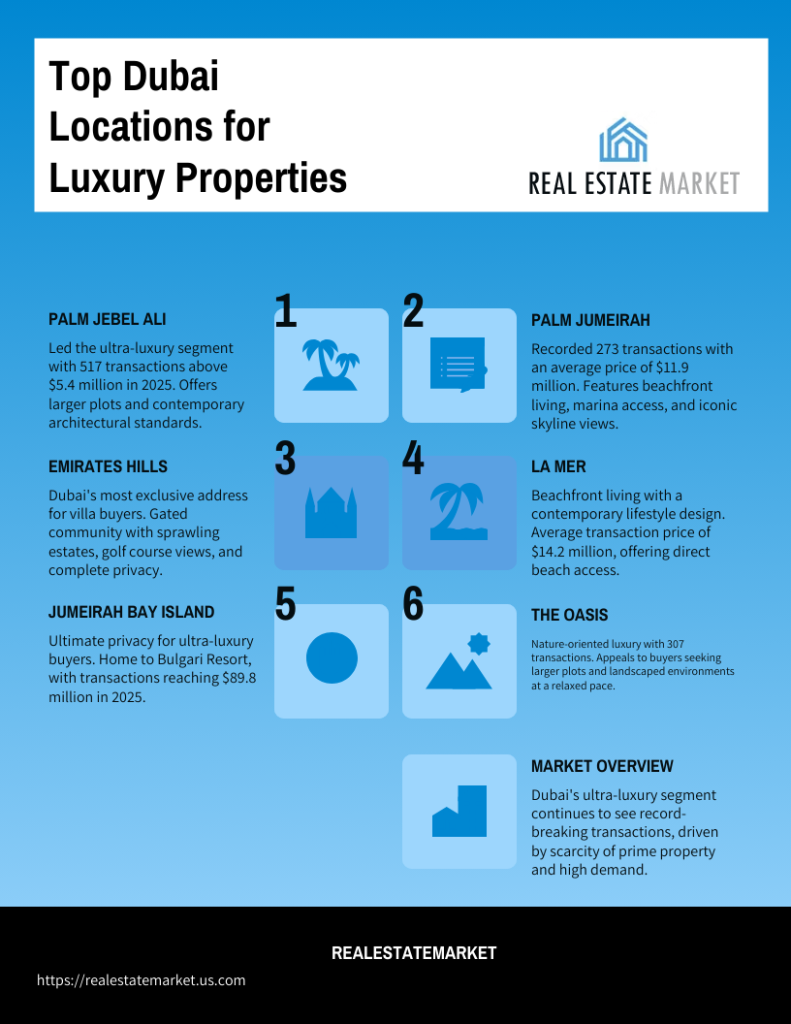
Palm Jebel Ali led the ultra-luxury segment with 517 transactions above $5.4 million in 2025, reflecting strong demand for the ambitious development that expands on the success of the original Palm Jumeirah. The new palm-shaped island offers larger plots, more privacy, and contemporary architectural standards that appeal to today’s luxury buyers.
Palm Jumeirah, the original and most established of Dubai’s signature developments, recorded 273 ultra-luxury transactions with the highest average price among top areas at $11.9 million (AED 43.9 million). The island’s maturity, proven track record, and limited supply have created a scarcity premium. Properties here offer beachfront living, marina access, and views of Dubai’s skyline, making them perennial favorites among luxury buyers.
Emirates Hills remains Dubai’s most exclusive address for villa buyers. This gated community features sprawling estates with golf course views, complete privacy, and proximity to premium schools and amenities. The area recorded multiple transactions above $60 million in 2025, with Sector E and Sector V commanding the highest prices.
La Mer represents a newer addition to Dubai’s luxury landscape, offering beachfront living with a contemporary, lifestyle-oriented design. The development recorded an average price of $14.2 million (AED 52.3 million) among its luxury transactions, reflecting the premium buyers place on direct beach access combined with urban convenience. The area’s boutique hotels, restaurants, and retail create a vibrant community atmosphere while maintaining exclusivity.
Jumeirah Bay Island offers the ultimate privacy for ultra-luxury buyers. This man-made island, home to the Bulgari Resort and Residences, provides complete seclusion while remaining just minutes from downtown Dubai. The island recorded transactions at $89.8 million (AED 330 million) and $61.3 million (AED 225 million) in 2025, demonstrating sustained demand for this ultra-exclusive location.
The Oasis, a newer development focused on nature-oriented luxury, recorded 307 transactions above $5.4 million with an average price of $6.5 million (AED 24.0 million). This community appeals to buyers seeking larger plots, landscaped environments, and a more relaxed pace while remaining connected to Dubai’s business districts.
Investment Returns and Market Outlook
Dubai’s luxury real estate market has delivered consistent capital appreciation alongside strong rental yields, a combination rare in global luxury markets. The 6.7% year-over-year price increase in 2025 reflects sustainable growth rather than speculative excess, as the gains came alongside record transaction volume indicating genuine market depth.
Currency dynamics favor international buyers, particularly those earning in strong currencies like USD, GBP, or EUR. The UAE dirham’s peg to the US dollar at 3.67 AED provides exchange rate stability, eliminating currency risk for dollar-based investors. For European and British buyers, the dirham peg means straightforward currency planning without the volatility that affects other emerging markets.
Exit liquidity remains strong in established luxury locations. Palm Jumeirah’s 273 ultra-luxury transactions demonstrate active market depth, while Emirates Hills’ consistent high-value sales prove that trophy assets can be successfully monetized when sellers choose to exit. The key is selecting properties in proven locations with sustained demand rather than chasing new developments in unproven areas.
Dubai’s luxury market also benefits from zero property taxes, no capital gains taxes, and no inheritance taxes. For high-net-worth individuals, this tax efficiency significantly impacts total returns compared to markets like the United Kingdom (stamp duty, council tax, potential capital gains), the United States (property taxes, federal and state taxes on gains), or France (wealth taxes and transaction taxes).
What International Buyers Need to Know
Foreign buyers can own property outright in Dubai’s designated freehold areas, which include all major luxury developments. The transaction process is straightforward: buyers engage a licensed real estate agent, conduct due diligence, sign a purchase agreement, and complete the sale through Dubai Land Department. The entire process typically takes 2-4 weeks for ready properties.
Financing is available through UAE banks and international lenders, though most luxury buyers in the $5.4 million+ segment purchase with cash to streamline transactions. UAE banks typically offer mortgages up to 60-70% loan-to-value for non-residents, with competitive interest rates ranging from 3-5% annually.
The Golden Visa program offers 10-year residency to property buyers who invest a minimum of $545,000 (AED 2 million) in real estate. This long-term residency visa extends to immediate family members and doesn’t require physical presence minimums, making it attractive for international investors seeking a foothold in the UAE. For luxury buyers spending well above this threshold, the Golden Visa is a standard benefit that provides flexibility for business and lifestyle planning.
Legal due diligence should include verification that the property has clear title, no outstanding service charges or developer payments, and proper completion certificates if buying a ready property. Engaging a qualified real estate agency with market expertise helps navigate these requirements and ensures transactions proceed smoothly.
2026 Market Outlook
Market forecasts for 2026 point to continued growth in Dubai’s luxury segment, albeit at a more moderate pace than the exceptional gains of 2023-2025. Prime residential prices are expected to rise 3-5%, reflecting the market’s maturation while still offering appreciation potential for investors.
Supply considerations remain favorable for the luxury segment. While Dubai has a significant pipeline of mid-market apartments scheduled for delivery, ultra-luxury supply remains constrained. Developments in the $5.4 million+ range require longer construction timelines, prime land parcels, and established developer credentials, limiting how quickly new supply can enter the market.
For buyers considering entry in 2026, the market offers a more balanced environment than the momentum-driven conditions of recent years. Buyers have greater negotiating leverage, more time for due diligence, and can be selective about location and property quality. This shift from urgency to considered decision-making favors investors focused on long-term value.
